Seasonal
Ice storms and Piedmont trees
Freezing rain is the reason most trees come apart in this part of North Carolina. Here is the arithmetic behind that, which species it finds first, and the work that reduces the risk.
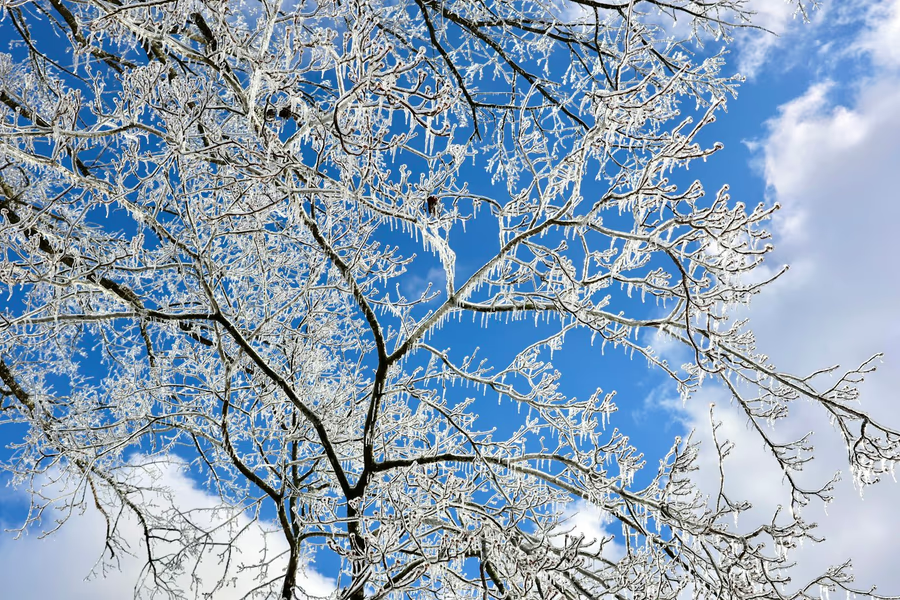
People move here from further north and assume snow is the winter tree hazard. It is not. Snow slides off a leafless hardwood crown. Freezing rain does not: it arrives as liquid, runs over every surface it touches, and freezes there, building a shell of clear ice on every twig in the canopy. That is glaze, and the Piedmont sits in exactly the part of the country where winter storms most often arrive in that form rather than as snow or as plain rain.
December 2002, the benchmark
The reference event for this region happened on December 4 and 5, 2002. The North Carolina Utilities Commission recorded a major ice storm blanketing forty North Carolina counties with up to an inch of ice, affecting approximately two million electric utility customers. Peak outages reached roughly 1.8 million customers by December 6, and power was not completely restored until December 14. Twenty-four deaths were reported, and property damage was estimated at $113 million by the North Carolina Insurance News Service.
Most of that damage was trees. An inch of ice does not break power poles. It breaks the limbs that fall on the lines attached to them, and it does so across a whole region at once, which is why restoration took ten days rather than one.
What an inch of ice weighs
Take a single limb, twenty feet long and two inches thick. Its own green weight is around twenty-seven pounds. A quarter inch of radial glaze around it adds roughly fourteen pounds. Half an inch adds thirty-one, which roughly doubles what the limb is holding up. A full inch adds about seventy-five pounds, close to four times the limb's own weight, and that is before counting a single twig.
The twigs are where it becomes serious. A twig has enormous surface area for its volume, so it collects far more ice per pound of wood than the limb behind it does. A mature crown carries thousands of them, all out at the ends of the branches where the leverage is greatest. That is the whole mechanism: ice loads the tips hardest, the tips are furthest from the trunk, and the bending moment at the branch union goes up accordingly.
Which trees break
Failure is about structure rather than about species toughness in the abstract, but in this region the same names come up every time.
- Water oak. Widely planted, long horizontal limbs, and internal decay that develops earlier than in white oak. A water oak with a hollow at a limb union is the classic Piedmont ice casualty.
- Callery pear, sold as Bradford. Its branches emerge in a tight crowd from nearly the same point on the trunk, producing exactly the narrow unions that split. It is also recognized as invasive in North Carolina.
- Silver maple. Fast growth, soft wood, and heavy end weight.
- Pine. Loblolly and Virginia pine hold needles through the winter, so they collect ice on a huge surface, and they bend rather than shedding limbs until the top snaps out.
- Anything with a codominant fork. Species matters less than structure here, and a tight V-shaped union with bark trapped in it is a weak point in any tree.
Why codominant forks fail
When a branch is clearly smaller than the stem it grows from, the tree lays down wood across the join every year and builds a raised collar. That connection gets stronger as the tree ages. When two stems of equal size rise from the same point, neither is subordinate, and instead of wood knitting across the join, bark gets folded down into it. That is included bark. There is no wood connecting the two stems through the seam at all, only pressure holding them together. Load it with ice and it opens.
This is the defect worth finding on your own trees, and it is visible from the ground. Look for a fork where the two stems are similar in thickness and meet at a narrow angle, with a line or a seam running down between them rather than a raised ridge.
What reduces the risk
End-weight reduction. Shortening long limbs back to a suitable lateral branch reduces the leverage at the union without removing the tree's ability to feed itself. This is the single most effective pre-storm work there is.
Deadwood removal. Dead limbs are already the ones most likely to come down, and they come down whether or not there is ice.
Structural pruning while trees are young. Correcting a codominant leader on a fifteen-foot tree costs almost nothing and permanently removes a defect that would otherwise be a several-thousand-dollar problem in thirty years.
Cabling and bracing, sometimes. Where a valuable tree has a union worth supporting rather than removing, hardware installed by somebody who does it regularly can extend its life. It is a maintenance commitment rather than a fix, since the hardware has to be checked every few years.
What does not work
Topping. Cutting limbs back to stubs is the most common thing people do in the hope of storm-proofing a tree, and it makes the tree more dangerous. It removes the leaf area the tree lives on and triggers a flush of fast, weakly attached shoots from the cut ends. Within a few years the tree is back to a similar height with far worse attachments than it started with. A topped tree fails harder in the next ice event, not less.
Waiting until the forecast. Nobody is pruning a mature oak in the forty-eight hours before a winter storm, and no crew should promise to. This is quiet-season work, which is another argument for having it done in a normal December rather than a memorable one.
After the storm
Triage first: people, then power lines, then structures, then everything else. A tree resting on a roof and a limb hanging in a canopy are different urgencies from a trunk lying harmlessly across a lawn. Photograph everything before anything moves, because the pictures taken before cleanup are what an insurance claim rests on. And treat a stripped but standing tree as an open question rather than an automatic removal, since hardwoods rebuild canopy and the decision reads much more clearly a season later. The storm damage page covers the sequence.
Want the forks on your trees looked at before winter?
Call (336) 729-8100, or send the quote form and somebody will call you.